
Addressing Water Scarcity via Solar-Powered Groundwater Treatment System in Rural Cambodia: Benefits and Challenges
See how solar-powered groundwater treatment offers a sustainable solution to water scarcity and contamination in rural Cambodia, despite high upfront costs.
365_20260317_01
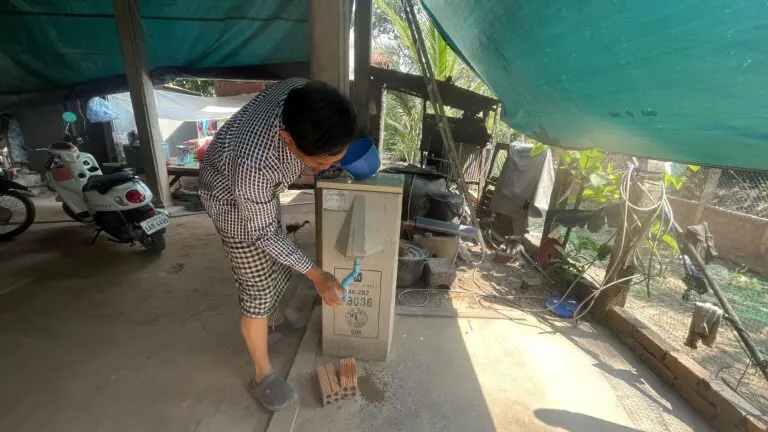
Vireak shows how the sand filtration system works. However, it is not effective in removing contaminants, hence an urgent need for reliable and safe drinking water solutions. Photo: Eung Sea
Produced by the MTT media-research collaboration fellowships 2025, this article discusses the benefits and implementation challenges of using solar-powered groundwater treatment systems to address water scarcity and contamination issues in rural Cambodia.
Vireak shows how the sand filtration system works. However, it is not effective in removing contaminants, hence an urgent need for reliable and safe drinking water solutions. Photo: Eung Sea
Siem Reap Province—Water scarcity is a growing global challenge, and in many regions, groundwater is a critical alternative to unavailable surface water resources. However, groundwater often requires treatment due to contamination.
In Southeast Asia, including Cambodia, groundwater can be contaminated with arsenic, iron, manganese, and fluorides, posing significant health risks. This is particularly problematic in remote areas, as seen in many parts of Cambodia, where access to electricity for conventional water treatment is limited. Therefore, small-scale, sustainable groundwater treatment units are essential for addressing water scarcity in these regions.
A team of researchers from the Water Environment Laboratory of Institute of Technology of Cambodia, launched a project called “Addressing Water Scarcity through Groundwater Use: Development of Solar-Powered Groundwater Treatment System for Remote Area of Cambodia”. The goal is to develop a solar-powered groundwater treatment system for remote Cambodian communities.
Researchers collected groundwater samples from 14 wells in Preah Dak commune, Siem Reap province and analyzed them based on chemical and physical parameters. A laboratory was established to conduct crucial experiments. Statistical analysis of groundwater quality parameters of the samples indicated harmful substances — high levels of turbidity and iron, exceeding WHO guidelines for iron. It means groundwater treatment is needed to ensure safe drinking water for rural communities across Cambodia…
Click here to continue reading.
This story was written by Eung Sea as a part of MTT media-research collaboration fellowship and was published in CamboJA News: Addressing Water Scarcity Via Solar-Powered Groundwater Treatment System in Rural Cambodia: Benefits and Challenges
MTT media-research collaboration fellowship
In January 2025, SEI’s Mekong Thought Leadership and Think Tanks Network Program (MTT) awarded six “media-research collaboration fellowships”, each worth up to US$ 3,400 (AUD 5,000), to selected journalists and multimedia producers from the countries of the Mekong Region for environmental reporting.
During the fellowship from January to December 2025, the media grantees have produced a range of stories, blogs, and short films on diverse environmental issues in the Mekong Region. The outputs were produced in collaboration with the MTT-affiliated researchers in the Mekong Region. The media grantees also organized a series of trainings and collaborative learning sessions for the MTT researchers in order to build the researchers’ capacity in multimedia and media engagement.
The media-research partnership fund is coordinated by SEI Asia with the generous support of DFAT, Government of Australia.

