Bridging local knowledge with scientific understanding: Co-creating a Mekong Curriculum
In late February, Dr. Kanokwan Manorom began the process of co-creating a local curriculum to support the integration of knowledge across community members and boundary partners for the SUMERNET research project Co-creating Knowledge to Enhance Women’s Leadership for Inclusive River Governance and Livelihood Resilience in the Mekong Region.
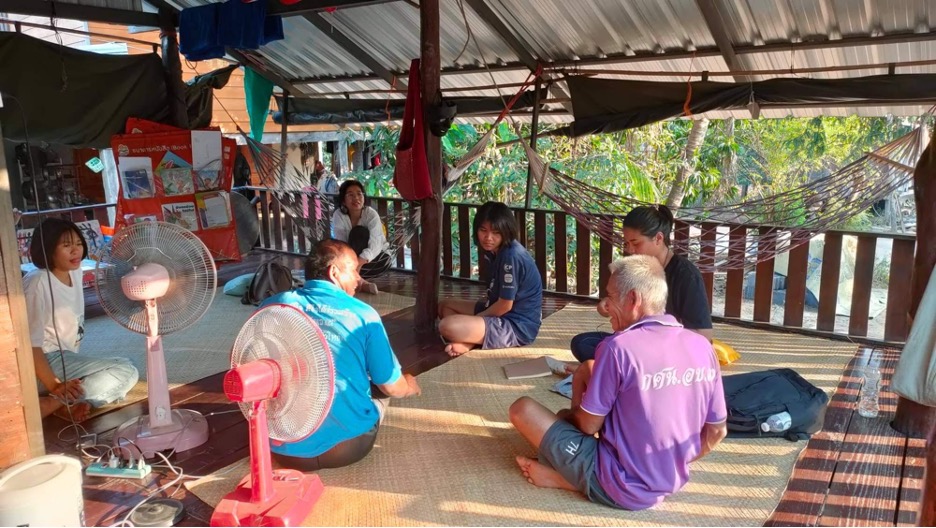
Her conversations highlighted how diverse understandings are, both of the Mekong and of the concept of co-creating knowledge. The commonality across all who responded was the need to share and connect different understandings to have a shared vision for the Mekong River.
One participant captured the sentiment of many: “We have different thoughts about things. Someone wanted to build something different from others. We must come to think and talk about how we will do things to get common understanding before we start doing things together, like where to fish. Even if we have different knowledge and skills, we must have the same goal.”
The Mekong Curriculum is developing in a way that bridges local knowledge with scientific understanding, and also engages students in hands-on activities to support traditional ways of living and livelihood resilience. Primary school students will start with a cotton weaving curriculum, growing cotton along the banks of the Mekong and learning how to weave cloth and plant protection. Another school will cultivate bamboo, which is becoming increasingly rarer to find, and learn how to make bamboo baskets. A third school will focus on riverbank agriculture and learning about the kinds of fish in the Mekong. Peoples of all genders, young and old, are actively involved in curriculum development.
Articulating shared goals, values and visions that incorporate divergent perspectives from all stakeholders that use and rely on a river is the first step in the co-creation of knowledge process. Where women’s voices and women’s leadership have not always been a part of governance, the co-creation approach and the co-creation of the Mekong curriculum is designed to be a participatory and inclusive process to support a broader understanding, from an early age, of the cultural, scientific, and economic aspects of the Mekong. Young women who take part in the curriculum will grow into informed members of the community with a voice that will be heard to guide the future of the Mekong.
Info
This story is part of the following project
SUMERNET 4 All: Engaging with water insecurity in the Mekong Region
Topic
Country
Related people

You might be interested in
-
SUMERNET Vision Guide introducing the new phase "SUMERNET 4 All"
The new, revised "Vision Guide" for SUMERNET is now available. This vision guide presents an overview of SUMERNET - its origins and governance structure, background to the network, aims, key research areas, engagement with policy, and outreach products
![SUMERNET Vision Guide introducing the new phase "SUMERNET 4 All"]()
-
SUMERNET 4 All Call for Proposals on Joint Action
SUMERNET 4 All (S4A) provides financial support and technical assistance to consortia of researchers and boundary partners from the Mekong Region
![SUMERNET 4 All Call for Proposals on Joint Action]()
-
SUMERNET launches redesigned website to provide a fresh visual look and direction
SUMERNET is proud to announce the launch of our redesigned website to coincide with our new phase of work on addressing water insecurity in the Mekong Region.
![SUMERNET launches redesigned website to provide a fresh visual look and direction]()


 Read more about SUMERNET
