Thailand’s Eastern Economic Corridor: Is it a gateway to “green growth” in the Mekong Region?
This piece reflects on the session on green investment and intra-regional trade through the Eastern Economic Corridor (EEC) organized as part of the Mekong Forum 2026 held in Bangkok 22-23 July.
 By Thinn Nay Chi Sun
-
Sep 10, 2026
By Thinn Nay Chi Sun
-
Sep 10, 2026
The Mekong Region stands at a critical juncture, seeking new pathways for industrialization and sustainable development. Economic corridors are evolving beyond their traditional roles, driven by green investment, innovation, regional cooperation, and the global shift toward low-carbon development. As the countries in the Mekong Region pursue industrialization while addressing climate change and shifting supply chains, a pivotal question emerges: Can economic growth be both sustainable and competitive?
This question was at the heart of a side event “Pioneering sustainable hubs in the Lancang-Mekong Region: Advancing Green Investment and Intra-Regional Trade through the Eastern Economic Corridor (EEC).” The side event was organized as part of the Mekong Forum 2026 held in Bangkok.
Established in 2017 as a part of Thailand 4.0 strategy, Thailand’s EEC aims at a modern economic corridor to advance national development while supporting cross-border regional ambitions for green growth and regional connectivity. The EEC covers the eastern provinces of Chonburi, Chachoengsao and Rayong.
Thailand 4.0 is a strategic initiative ambitioned to transform Thailand from a traditional, manufacturing-led economy into a more innovation-driven, technology-centric model. It has since expanded beyond its initial goal of modernizing the country’s industrial base, emerging as an industrial corridor that integrates regional value chains, logistics, and investment opportunities in green industry, clean technology, and low-carbon industry.
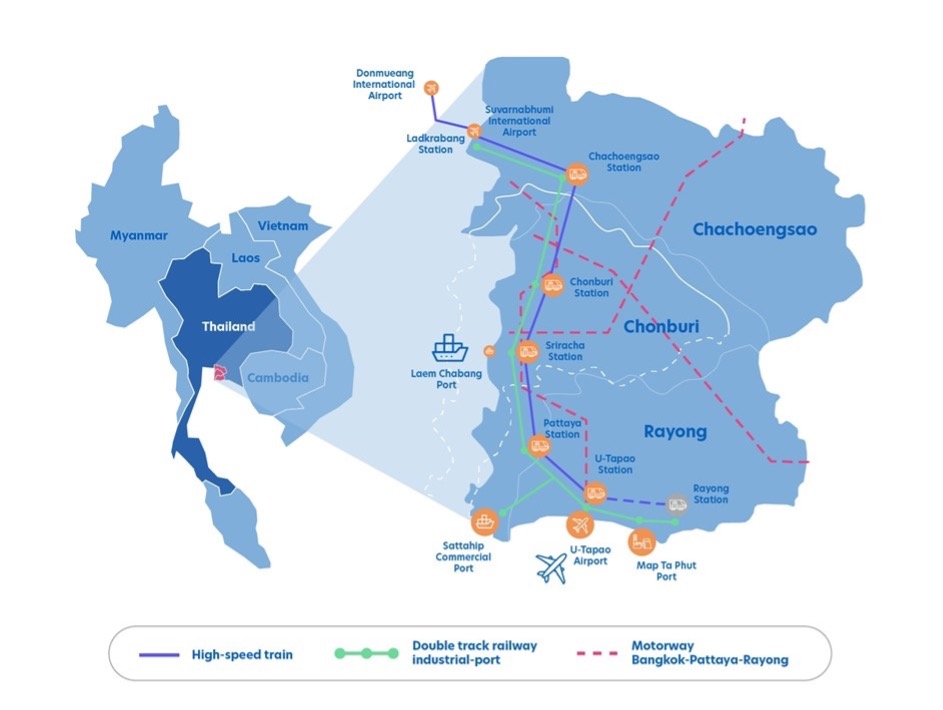
EEC map showcasing ongoing infrastructure projects aimed at boosting regional connectivity. Photo: UOB
Why the EEC matters
Strategically located at the center of mainland Southeast Asia, the EEC serves as a pivotal hub for green industrial transformation. Its advantages include robust logistics connectivity, deep sea-port access, advanced ICT infrastructure, industrial estates, and a skilled workforce.
During the keynote speech, Dr. Pisesporn Wasawong, Consultant, Mekong Institute Economist and Investment Specialist, said that
The EEC is an opportunity to move from an industrial corridor toward a low-carbon regional production and investment hub by accelerating the transition to a low-carbon economy.
The EEC is trying to develop integrated sustainability by building environmentally friendly industries, improving logistics, strengthening human capital and supporting innovation through the Bio-Circular-Green (BCG) Economy Model. But how far has it achieved its aims to reconcile being a production base and a gateway to industrial development while aligning with climate objectives is still under question.
At the same time, the EEC's sustainability agenda gets criticism form environmental activists, civil society organizations, and local communities. While the corridor promotes eco-industrial development, circular economy practices, and incentives for investments that contribute to greenhouse gas reduction, carbon neutrality, and net-zero targets, there is still a concern about the effectiveness of implementation and monitoring on the ground. Large-scale industrial expansion and infrastructure development can generate environmental pressures, including increased energy demand, and impacts on natural ecosystems. When it is ensured that sustainability commitments are translated into measurable environmental outcomes, it will require strong environmental governance, transparent assessment processes, and meaningful engagement with local communities. In that way, economic benefits can be shared while environmental and social concerns are properly addressed.
From industrial zones to sustainable economic hubs
In the past, economic corridors were measured by the investment volume and industrial output. Today, the objectives have changed: investors, governments, and communities expect industrial development to contribute to long-term sustainability. The EEC’s development objectives now include modern infrastructure, smart cities, appropriate land use, and environmentally friendly economic activities.
By prioritizing green industries such as renewable energy, recycling, biochemicals and circular economy sectors, the EEC is positioning itself as a role model for economic development in the region. It combines policy, infrastructure and human capital development to transform investment into sustained productivity.
Beyond infrastructure development, the EEC has adopted a demand-driven approach to workforce development, aligning training with the industry needs. Curricula are designed in collaboration with employers, combining classroom teaching with work-integrated training. The EEC also supports reskilling and upskilling programs to help workers adapt to technological change and digitalization. By strengthening human capital, the EEC is building a workforce capable of supporting advanced industries and green investment.
New opportunities for green investment
As the EEC grows, the transition to a green economy is creating significant opportunities across the Mekong Region. Key green investments are flowing into clean energy, advanced manufacturing and circular industry sectors. Priority sectors include food and agriculture, biofuels and biochemicals, renewable energy, hydrogen, waste management, and recycling, all of which fit the broader regional transition toward low carbon trade and sustainable resource management.
The EEC offers incentives that reward sustainability. Net-zero goals, such as carbon neutrality and greenhouse gas reduction, are among the criteria used to evaluate investment proposals. Eligible projects can receive tax benefits including corporate income tax exemptions for up to 15 years together with other non-tax benefits. Moreover, the EEC is raising green standards and creating demand for cleaner industries, serving as a gateway for building supply chains across the Mekong Region.
Green and circular investment opportunities are developed in the region with the support of technological services, resource management and digital automation while reducing resource usage in production,
said Mr. Angsutorn Wasusun, Director of Bio-Circular-Green Economy Division, EEC Office, Thailand. The promotion of circular economy led to production efficiency improvement and resource management in the existing factories.
As global investment is moving toward sustainable industries, the EEC demonstrates how economic corridors can transform into an ecosystem for green growth. The transition is not only an opportunity to strengthen industrial competitiveness, but also a pathway toward a more sustainable future for the Mekong Region. The EEC’s long-term success will be measured by its ability to enable resilient and competitive regional economies, aligning industrial needs with regional connectivity and inclusive development.
By linking investment promotion with environmental compliance, workforce development, and regional partnership, the EEC can become a blueprint for greener and more resilient growth and connectivity.
 Read more about SUMERNET
