Why strategic financing matters for integrated and sustainable solutions in the Mekong Region?
This piece gathers observations and reflections from the session on “governance, people, technology and finance as enablers of adaptive and integrated development” organized as part of the Mekong Forum 2026 held in Bangkok 22-23 July.
 By Thinn Nay Chi Sun
-
Sep 10, 2026
By Thinn Nay Chi Sun
-
Sep 10, 2026
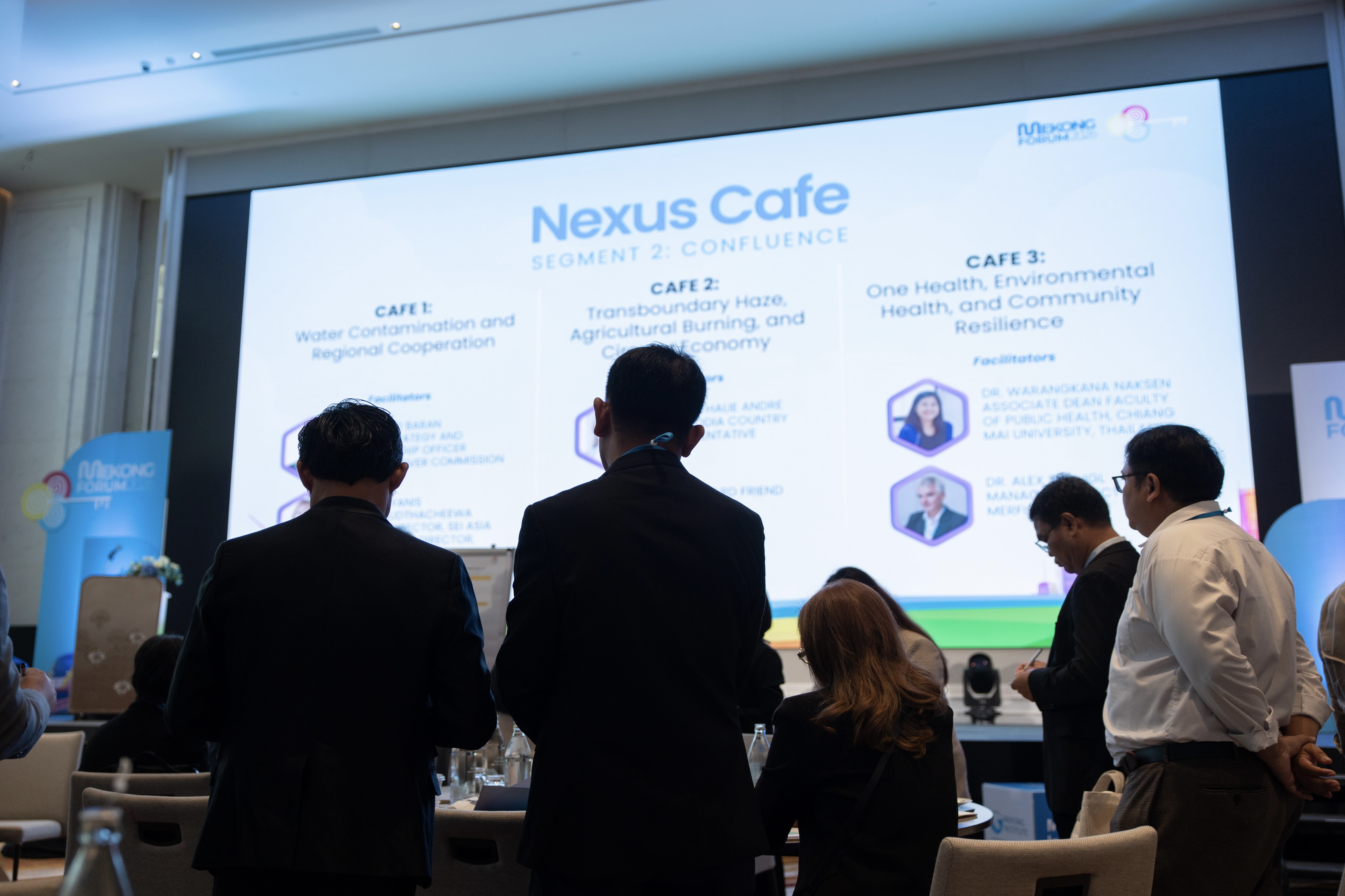
With the Mekong Region facing complex development dynamics such as cross-border crime, online scams, water and energy security concerns, and environmental issues, traditional sector-based development approaches are not adequate to tackle these complex cross-border issues.
At the Mekong Forum 2026, participants explored how the region can adopt a nexus solution which benefits more than one sector and manages trade-offs and reinforces systematic approaches across sectors. Rather than addressing problems in each sector separately, the nexus approach utilizes the interdependence between climate resilience, governance, energy, water, food security, and inclusive economic development.
Consequently, for the nexus approach to work, financing must likewise develop integrated investments rather than standalone projects. For example, digital infrastructure should simultaneously enable trade, financial inclusion, education, and public services. Similarly, investments in renewable energy need to enhance regional connectivity and reduce carbon emissions.
From funding projects to building investment ecosystems
Currently, physical, digital, and green infrastructure in the region is still financed in silos.
As Mary (Milo) Losmithgul of the Asian Infrastructure Investment Bank (AIIB) said:
Infrastructure financing remains highly fragmented. As different financers apply different criteria and financing instruments, it becomes more challenging for integrated development to implement.
Moreover, public finance alone cannot meet the region’s growing infrastructure needs. Although significant private capital is available globally, investors remain reluctant to invest in emerging markets due to regulatory uncertainty and investment risks.
Strategic financing can help overcome these barriers through innovative financial structures. Cross-sector financing is critical in allowing climate resilience, digital connectivity, and infrastructure to be developed together instead of separately. Tools like blended finance, public-private partnerships, and catalytic grants need to be embedded to attract private investors while mitigating risks.
ASEAN power grid: A model for nexus financing
The ASEAN Power Grid (APG) is an example of an integrated financing model, requiring long-term, multi-country collaboration and blended finance. By 2045, the APG aims to create a connected regional electricity network that facilitates cross-border energy trade and accelerates renewable energy adoption across Southeast Asia. Since no single government or institution can finance regional interconnection alone, a coalition of financers' approach, combining public funding, multilateral development finance, private investment, and regional cooperation, is essential. This collaborative approach could also be applied to Mekong climate-resilient infrastructure, regional logistics corridors, and digital connectivity networks.
Investing in people, not just infrastructure
Strategic financing lies at the heart of regional connectivity. But it must go beyond large-scale infrastructure. Future investments must prioritize youth, vulnerable communities, micro-, small- and medium-sized enterprises, and startups.
Building adaptive capacity requires investing in people as much as physical assets. In the short term, seed funding, grants, microfinance, and community-based financing should be expanded. Over the medium and long term, efforts should focus on vocational training, digital financing platforms, and integrated STEM education to help local enterprises access new markets.
During the discussions, participants highlighted that strategic financing is not only about mobilizing more capital but also about ensuring investments reach the people and communities that need them most. The Mekong Region is facing challenges such as financing and data gaps, limited institutional and technical capacity, and unequal access to education and resources, which continue to limit development outcomes. Ms. Thao Tran, General Director of New Energy Nexus Vietnam, highlighted that the Greater Mekong is entering a new stage of development shaped by complex geopolitical and economic dynamics.
The future of the region will depend not only on infrastructure and technology but also on its capacity to innovate, build skills, and strengthen institutions,
she noted. Participants further emphasized that strategic investments should support MSMEs and startups, expand access to finance and vocational training, and promote climate-resilient technologies, digital innovation, and community-based financing mechanisms to ensure that development is both inclusive and sustainable.
When finance becomes an enabler of inclusive growth, strategic investment can support climate-resilient technologies in agriculture, remote sensing for disaster response, and AI-integrated environmental monitoring. Such investments can generate multiple benefits simultaneously by strengthening climate resilience, fostering innovation, and improving livelihood by incorporating the essence of nexus solutions.
The future of the Mekong depends on its ability to connect and build a more resilient, sustainable future. By aligning capital with regional priorities and fostering cross-country collaboration, strategic financing can transform the Mekong Region’s shared challenges into shared opportunities.
Ultimately, the region’s future will depend not only on how much capital is invested, but on how strategically it is used. Strategic financing is about connecting investment with regional goals, empowering people, and mobilizing partnerships across sectors. If the Mekong Region wants resilient, future-ready development, financing must move beyond supporting projects separately to enable integrated, long-term solutions that deepen regional partnerships.
 Read more about SUMERNET
